
Category Archives: Ministry and Church Life

Is There a Place for Apologetic Ministry Within and Without the Church?

ImageSeemingly irreconcilable conflicts are inherent to opposing world views, and at the center of them is Christianity. Often assumed is the specious idea that faith and reason are mutually exclusive. And this illusion is not going away in the foreseeable future. From this we learn that our objective as Christians is two-fold. On one hand, we must minimize the currently surmounting confusion in the skeptical mind by offering answers to difficult questions, while at the same time demonstrating to all that faith and reason needn’t be reconciled, for they are friendly neighbors in the biblical system of thought. In this series I will attempt to accomplish both of these objectives by way of a  limited case study I conducted recently. Firstly, I will identify the three most common questions raised by twelve people I interviewed. Secondly, I will interpret the cause of the questions. Thirdly, I will answer them. And finally, I will discuss the solutions that I believe best address the root of these issues.

1.1. What is going on in my church/community?

The questions that have come to me through my interviews in and out of our church community are numerous, but there are common threads that connect them and which allow me to narrow them down to three primary categories. They are 1.) the problem of sin, 2.) the problem of suffering in the world, and 3.) the problem of freewill.

1.1.1. The Problem of Sin

Pertaining to sin, the questions were about what it is and why it exists. Specifically, why did God give man the potential to sin, or at least after sin entered the world, why didn’t God simply eradicate it? Must sin continue as the cause of so much trouble today? One interviewee preceded Adam’s fall (Gen 3:6) with a question about Lucifer’s creation and his eventual banishment from heaven (Isa 14:12). Why did God create Lucifer if He knew that he would fall into sin, lead a celestial rebellion, and consequently become the great tempter and catalyst to man’s sin? Immediately following this came the logical perplexity for why God didn’t destroy Satan immediately. Because these questions all are so closely related to one another in that they deal with sin’s nature and origin, I have put them together under the single heading “The Problem of Sin,” which I will discuss shortly.

1.1.2. The Problem of Suffering

The problem of suffering, and why there is so much of it, must be the single most popular criticism against the existence of an omnipotent and loving God. Permeating this topic were similar questions pointing to specific instances of suffering, such as war, famine and sickness. The troublesome part for most of those interviewed was not so much why suffering exists, per se, but rather if God is all-powerful and good, why don’t we see Him doing anything about it? Once again, given the related nature of these questions, I have chosen to place them together under the single heading “The Problem of Suffering.”

1.1.3. The Problem of Freewill

Interestingly enough, this last question, “Does man have a free will?” is in a sense more of a doctrinal issue than it is apologetic. Doctrinal because it rises from the face of Scripture specifically, but still apologetic because some atheists (i.e. Sam Harris) deny that man has a free will at all. Human beings are nothing more than animalistic machines with refined behavior. Therefore I believe it is fitting to address the problem of free will here, within the context of an apologetics study, for two primary reasons. First, because it was a common enough question asked in the interviews for this case study. Second, and perhaps most importantly, because freewill lies very much at the crux of the other two questions listed, the “Problem of Sin” and the “Problem of Suffering.”

In my next post, part two of this three-part series, I will address the eyeopening socio-cultural influence behind these questions, which inevitably overflows into the context of church life. Stay tuned and let me know what uThink!

The Perfect Diaper Bag

The Perfect Diaper BagFriends, I hope you get a chuckle from the title of this post (not to mention the guy in the picture). Although today is Monday, and I would have loved nothing more than to sit back and post a little something on one of the endless array of subjects that peak my (and I think yours too) interest, what time I did have available for writing needed to be applied to our MUCH-overdo update on our primary ministry here.


Because uThinkology is part of our overall ministry, and the site has a dedicated page for our updates, I felt it was appropriate to include this November news letter as a post. So here it is, our latest update in PDF on our ministry and family in Treviso, Italy. I hope you will take a few minutes to see what is happening in our lives and in this part of the world. Just click here or on the “Ministry Updates” tab above on uThinkology’s site header. You’ll be able to open the PDF in your browser. You can also choose to download it if you like.

Thanks for stopping by uThinkology. And remember, you are what uThink!

Blessings,

Mark Nigro

Creation, Evolution or Both? A Visual Concept Map on the The Origin of Life

Origin of Life

A visual concept map on the three views for the origin of life

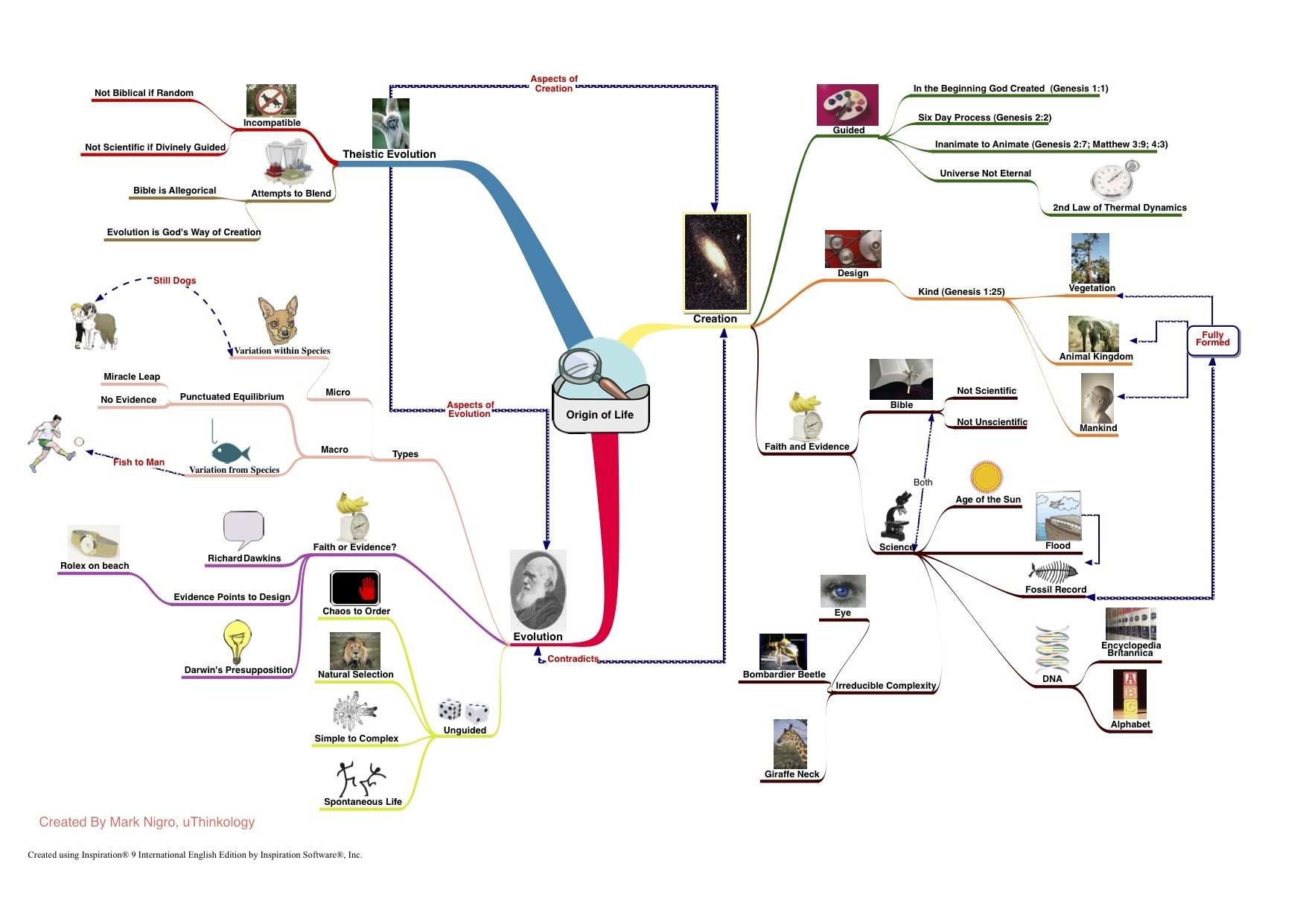
Today’s post is a mind-map entitled “Three Views on the Origin of Life.” I created this map to use as a visual guide for myself and for the congregation during Sunday morning’s message. Click on the image to enlarge it.

For the presentation, I broke the map into 15 sections, projected them as slides and walked the congregation through each main point. Visual presentations are proven to aid in learning and memory retention, so lately I’ve really made an effort to utilize them. On this map you will see dotted lines and arrows revealing the relationships and contrasts between the three views. It isn’t intended to be exhaustive, rather a brief overview that points to the soundness of Creationism’s view.

Easier said than done, however, with such massive subjects as creation and evolution. Choosing what to target and then fitting it into a 55 minute message (with translation from Italian into English) was nothing short of a miracle. It was a lot of work, but also a whole lot of fun. I hope you find it useful too.

I like employing mind-maps in my study preparation because they basically are a circular outline that read from the 1:00 o’clock position round clockwise. This provides a complete view of everything you need to cover, all on one page and in context, but (preferably) very succinctly. You get the whole “picture” if you will. It is freeing because one is not forced into a linear approach. I find that I don’t always think linearly, and, in fact, most people don’t.

At first, the apparent “busyness” of the map may seem overwhelming, but in reality it is very simple and logical to follow. Have a look and see if you can get the gist of it. To give credit where credit is due, I used a trial version of “Inspiration 9” by Inspiration Software ©.


A voice crying in the WordPress, or at least wanting to!

I felt I ought to let you know why there’s been such silence and what is coming down the pipe at uThinkology. As you can see, the waters have been a little still these last two weeks. I just really haven’t had the time to put together my thoughts. Well, that’s not entirely true. I have had the time, just not the right time. If you are someone who writes you will know exactly what I mean by that. There is a right and a wrong time to write. In the evenings after the children have been put to bed, I’m offered about one and a half hours, two max, before I follow in their wake. But during that time there isn’t much left of my brain to put words on paper, or on my laptop screen I should say. That is not the right time to write!

However, I am excited to say that I’ve got about a half dozen posts on the back burner covering a variety of subjects. I will be sure to put out at least one this week. If I make the coffee a little stronger, maybe I’ll even get two out there. Next up will be a post about Jesus and the children he encountered during his earthly ministry. Have you ever wondered why he pointed to them as the exemplars of his kingdom? I was so blessed by something my four-year-old son said to me the other day that it led to a lengthy look into the gospels, and then worked its way into a uThinkology draft.

Following that, we’ll return to the virtual pastor and the virtual church series to consider the effects our modern, technologically and market driven culture is having on the bride of Christ. I hope you’ll join the discussion when we get those up on uThinkology. What uThink on these subjects really does matter, and it will greatly affect your approach to church life.

Til then, every blessing!

The Virtual Pastor: Following a person, or a personality?

Recently I wrote an article on the subject of the Virtual Church (which you should read before moving forward with this post to see where I am coming from on certain points) and even at the time of writing it I had already been keen on future related posts. I received some interesting feedback as a result and I suspect there is more to come. Nonetheless, it would be unjust to consider that topic while overlooking the virtual pastor, who is by default a component of the virtual-church.

The virtual pastor is not a colorful vector image like those seen in computer-generated animations. Instead, he is the man whose Bible teaching is broadcasted from a church service to another predetermined location, typically a building with ample seating capacity. It is there that a congregation of believers gather infront of a screen to watch the message being given, thus forming a satellite church in the least flattering sense, if not better expressed as church via satellite.

This is a new form of pastoring, one that is hardly compatible with the biblical image of shepherding sheep. A pastor that is not present to tend the sheep is tantamount to a church not present to follow the pastor. Both are a contradiction in terms and defy the nature of their definitions (the church is a gathering; the shepherd is with his sheep).

Virtual methods may work well when they are employed by corporate America, but their regular usage in ministry only perpetuates an already unhealthy church mentality. After all, how should we expect congregants to perceive God’s design for his church when their pastor can serve them through the air waves? Or worse yet, when his job is perceived only to be the delivering of a message, the more common view of a pastor these days?

It all fails to model the personal aspect of a connected body for church life when the closest a congregation can come to their pastor is a digital image viewed from the front row. It goes against the very behavior a pastor would expect from the sheep. At this rate, a congregant may think it just as beneficial to skip service and watch online from the comfort of home. At least they’ll save on gas consumption.

This article is not a rebuke to the pastors or ministries that are making use of technology where there is no flesh-and-blood alternative and as a temporary solution to a logistical problem. I do however find much fault with, and no reason for, a pastor who broadcasts himself to another location. A church must have its own resident teaching pastor. As we will see in a future post, the virtual pastor really isn’t a pastor at all according to Biblical terms. I question both the means employed to reach this end, and the end itself.

Because this topic is rather vast in scope, I will be posting the article in a few or more segments as a mini series. No matter how tightly I may try to write it, putting everything in one post would be too long, or incomplete at best.

Following are some of the issues I intend to cover in subsequent posts. I welcome your suggestions as well.

1. The Biblical definition and function of a pastor

2. The definition and application of ‘virtual’ in ministry

3. The biblical incompatibility of the ‘virtual’ nature with the living nature of church

4. The ethical and practical problems that ensue from a ‘virtual’ ministry

5. The justifications given by some to support ‘virtual’ ministry

6. Better alternatives to the broadcasted satellite church

The Virtual Church, Part One: Where is Modern Technology Leading the Church?

Modern technology has brought us virtual pets, virtual homes and virtual flowers. Yes, we can even have virtual children now. In fact, on March 5, one Korean couple was arrested for letting their real baby girl starve to death while they obsessively raised a virtual child in an online video game. It is so tragic and disturbing that it is hard to believe! But the truth is that people are losing touch with the warmth of reality, and instead, they are embracing a cold and detached alternative. And do you know what else? The church is not far behind in this trend.

Today, church-life faces a subtle threat to its overall health. It comes not as an external enemy, but an internal anomaly. It is the fast-spreading mentality of believers who would argue that faithful attendance and participation in the local body is really not important, neither for themselves nor for the whole of the local church. Their presence just doesn’t matter. As far as their spiritual health is concerned, they’ll be fine. They’ll just turn on Christian radio, or internet streaming. Maybe they’ll download an MP3 or flick through the Christian channels on cable or satellite television and just have church at home. And as far as their part of service in the fellowship, everything’s already been covered by the guys up front.

If, like so many believers do today, you view church as something passively to be observed and not actually participated in, then the case I will bring to the table in these posts will appear to be groundless. On the other hand, if you are willing to consider this topic through the lens of Scripture, you may just have to readjust not only your perspective, but also your involvement and attitude towards the body of Christ and the life of the church. Consider the meaning of church biblically. Does it ever refer to a sermon? A bible study? Even a building? Never. Certainly, these things are an essential part of church activity, but they do not constitute…the church.

The very word itself in Biblical language gives us the insight we need to remember. It is “ekklesia” and the New Testament is peppered with the word. Seventy seven times to be exact, with the majority of occurrences appearing in the Epistles. When Jesus spoke of the church in the gospels (Matthew 16:18), he referred to the universal church consisting of all true believers of every generation and in every part of the world. Location is irrelevant. In the other instances however, location is very relevant. The Apostles spoke of the church as specific groups of believers that met together in different places. To name a few, the church in Ephesus, the church in Galatia, the church in Corinth, Rome, Philippi etc. So we see that the meaning of the word has everything to do with the people who first of all are in Christ and secondly, who come together in His name somewhere locally.

In terms of definitions, church can’t be broadcasted by satellite nor can it be had from the comfort of our living room unless our living room is where the church actually meets. In many parts of the world, this is the case. Due to a citywide traffic block a couple of Sundays ago, we did exactly that for our church fellowship here in Italy. We held the service right in my living room for any who could join us, and it was a blessing. But for the people who unfortunately were too distant to come by foot, the best they could do was watch and listen online. Sure, it was better than nothing, but it was not the real thing. The real thing is active and not passive, it involves the rich blessing of ones presence where there is a warm touch. It is face-to-face fellowship and breaking of bread together. Handshakes, hugs, and sharing a laugh. Bottom line, it is a gathering. And that is the meaning of  ekklesia. So when a person says, “Let’s just watch online and have church at home,” what they mean is let’s listen to the message. A message is good, but it is not church.

Why nitpick over such terms? Because meaning matters folks. And our understanding of these things will determine how we live our lives. Those who think church is just listening to a sermon are not only an ocean’s distance from the Biblical meaning of God’s household (Ephesians 2:19), but they are very close to robbing themselves and the local church of the rich blessings and fruit God intends to produce through their presence and their participation. Both are vital, neither can be virtual.

For part two of The Virtual Church series, click on this link “The Virtual Pastor.” Or in the meantime just give the subject some thought. What do uThink about the direction modern life is taking the church?

The Vacant Prayer Closet

I’d like to put something out there to all of you for discussion today. As the title suggests, it has to do with our prayer closet. Not the physical place we go to pray in private, but the practice of prayerful communion with the Lord himself. For the vast majority of Christians, the prayer closet remains a vacant place.

Today as I was sending an email reminder to our church that tomorrow evening is our monthly prayer meeting, I was struck by the discouraging reality of how few people ever come to a prayer meeting. This is not a phenomenon unique to our fellowship, but rather is more of a problem that continues to plague the modern church. And more importantly, I believe, prayerlessness is largely the reason for the ‘sensate’ lives lived by the majority of professing believers in the affluent West.

So, I must ask some questions, which I hope you will help me to answer.

1. Why wouldn’t a Christian, if s/he is truly that, want to pray and commune with the Lord and Savior of his/her soul?

2. Why wouldn’t a true believer find joy and look forward with excitement to the opportunity of locking arms with other brothers and sisters in Christ for a time of corporate prayer together, as we see with the early church in the book of Acts?

3. Is the lack of corporate prayer indicative of a lack of private prayer?

4. Is prayerlessness a sign of carnality, or is it a sign of something else?

5. Do you struggle with private prayer, corporate prayer, or both? If so, why do you think this is the case? If not, what are the reasons you enjoy participating and what would you say to those who do not share your experience?

6. Do you pray and attend prayer meetings because you want to be obedient to the Words of Jesus and the Apostles as they exhort us in the Scriptures, but nonetheless you do it reluctantly? And if so, what is your experience after you have participated? How would you encourage others who struggle to overcome the complacency or resistance of the flesh?

I’ve got many thoughts I would like to share on this, and I hope to encourage more prayer in all our lives, but the topic would become a very large post. Instead, I’ll break it up into segments. In the meantime, rather than ranting from my soap box, I prefer to know what uThink. Click on the ‘comment’ link below, and post your thoughts. Let’s discuss together this most-important topic.

Blessings in Christ to you today and throughout the week!

Times have changed, and so have the tools available for Bible study

Have you ever had to use a concordance to find that Bible verse you wanted to reference? Then, you looked for it but couldn’t find it because your reconstruction of the verse as you recalled it didn’t match the word order or the ‘words’ themselves in the concordance index? Unless you are like my wife who has a nearly photographic memory (she can tell you what I wore at Christmas time in 2002), the answer is yes. Finding your way around the Bible at times can be difficult, and finding a certain verse can be like finding a needle in a hay stack. Enter electronic Bibles and Bible study software.

In today’s era of technological advancement, Bible study and word or verse searching can be done at lightning fast speed. Even if you enter words out of the correct order or you can’t even remember more than one, it’s likely you’ll still find what you are looking for when using software. Although I still read and reference paper-based books, and have no intentions of giving up printed Bibles, I no longer own a printed concordance. In fact, my primary reference tools are digital and the ones I use daily reside right on my computer in my favorite Bible software, Accordance. Accordance is made for the Mac, but it can be run on a Windows platform with a free emulator. And on my iPod touch, I use Bible Reader, by Olivetree, available in several mobile platforms such as Palm Pilot, Blackberry and others. With these applications, I always find what I need and I find it fast.

I have heard some people say that using a computer to study the Bible is cheating. But that is hardly true. If doing things the old-fashioned way means being more spiritual, let’s all go back to clay or stone tablets. Or how about unrolling a scroll at church service to follow along during the message. Or…well, I think you get the point. Perhaps the naysayers are under the impression that you enter a verse and the computer does all the work for you, even generates a sermon. The truth is, Bible study on the computer does nothing more than accelerate the process you would normally employ to study with print books. You still need to think, follow a line of thought, research, read and, we hope, hear from the Lord.  The machine simply makes your tools so accessible that flipping through hundreds of pages for research is no longer necessary. In one word, convenience.

Bible study software for me has not replaced the joy and intimacy of holding and writing in my print Bible, and it never will. I also still love to sit back with a good book in hand. And let’s face it, for extended reading the backlit screen of any electronic reader (other than say, the Kindle or similar device) is rather unfriendly to the eyes. But for shorter sprints of reading and reference work, computer-based Bible study is the way to go. Anyone who owns a computer and enjoys digging into the Scriptures wont regret the digital approach, it can’t be beat

From the new believer to the seasoned saint, there is a world of reference works available at your finger tips. Potentially, you could do such things as simultaneously compare multiple translations of the Bible (NIV, KJV, NASB etc.), look up a word’s definition in English, or consult the biblical languages (Greek, Hebrew and Aramaic). You could reference commentary or get statistical information, such as how many times the word ‘love’ is used in 1, 2 and 3 John. By the way, the answer to that is 42 times. See the screen shot below from my word search in Accordance that took all of about 0.2 seconds. The hits are highlighted in bold red. Click on it to enlarge.


In print, you would have to physically read all three books of 1, 2 and 3 John, and take note of each occurrence. With software, it takes less than a second. If you have maps, you can find any location named in the entire Bible, or even read a dictionary’s article on it. The screen shot here is from my Accordance atlas in which I located Ephesus instantly by just selecting the word in Acts 18:19 and then clicking on the atlas icon. Again, locating this in paper format would require at least a couple of minutes, if not more. Click the image to enlarge it.

The possibilities are endless. Personally, I love to study the Bible and absolutely am thrilled to be able to do it in the way that software allows me to. Any tool that helps you to cover more ground – especially such precious grounds as Scripture – more thoroughly, should be employed.

For ultra portability, I use Bible Reader by Olivetree. It offers its reader for free, along with a few Bible translations and other resources. But they also sell an extensive selection of basic to even the most advanced form of Bible study tools. Having Bible Reader on my iPod is indispensable while away from my Mac and can’t access Accordance. I can do simple to complex word searches, reference commentary, view maps and practice reading the original Greek. Twenty years ago we would have had to carry around a bunch of books. Well, times have changed, and so has the form of tools for Bible study. Whether you go the digital route or not, I just hope you’ll study the Bible. But if you are reading this post it’s likely you own a personal computer of some kind, so why not give the electronic way a try? Imagine, the world of the Bible at your fingertips…what more could you ask for? To see more about approaching Bible study, see “Pad, Pen and Prayer; Slowing Down for Bible Study.

Seminary or Cemetery?

Academically inspired death

A pastoral thought to my fellow servant leaders in ministry. In the past I have often heard (and even poked fun myself), the play on words between seminary and cemetery. This is as if to say that seminaries are nothing more than breeding ground for dead orthodoxy, whose occupants cannot be but lifeless theologians. But can we fairly criticize anyone for committing ones life to deeper study of Scripture, and more effective ministry? Unfortunately, we belittle them while simultaneously contradicting ourselves and becoming hypocritical in our practice. Before you become pharisaical and seek to stone me for my words, read on.

I can understand why we might have an aversion towards the academic world. After all, many liberal theologians, and indeed secular institutions, have done great damage to the hearts and minds of countless believers. With the undue emphasis in some denominations on formal education, and their criteria for ministry, even some of the first-church Apostles would be disqualified for ministry. This couldn’t be more erroneous.

But let’s not throw out the baby with the bathwater. For here is an enigma that I feel compelled to bring up. Although we often ridicule those in the academic field of theology, whether tongue-in-cheek or veraciously, time and time again we turn to their written works. Resources such as dictionaries, commentaries, lexicons, atlases, archeological journals and so on, become our friends and helpers to aid us in our study. So while we criticize the approach of today’s theologians and their predecessors, we at the same time by our actions acknowledge their work and the benefit they have brought to the body of Christ. Their diligent efforts of study in a specialized area of Christianity occupy the majority of real estate on our bookshelves, and for some of us, in our Bible software.

So then, are we not being unfair, and dare I say, hypocritical if we let them do the hard work for us, while we reap the rewards of their labor and then call them theological corpses? To help shed some light on what I mean, take a look at this truncated list of theologically educated saints who, through their speaking and writing ministries, have helped myriads of believers “grow in the grace and knowledge of Jesus Christ” (2 Pet 3:18). It is likely that you also turn frequently to these for Biblical insights:

• H.A. Ironside • William MacDonald • John F. Walvoord • Roy B. Zuck • D. A. Carson • R. Kent Hughes • James Montgomery Boice • Griffith Thomas • M. R. DeHaan • Irving Jensen • Warran Wiersbe • J. Vernon McGee

These are just a handful from my shelf, for this blog would be unnecessarily long otherwise. And the list is miles-long in the history of Christendom.

Now, we don’t have to agree with everything coming out of seminaries. Surely, I don’t! But personally, I am grateful to the Lord and to his servants who continue to make it possible to access invaluable information that would have otherwise taken me a lifetime to gather. In the end, we Bible students, and especially Bible teachers, are better for it.

I view seminarians, those who are genuine brothers and sisters in Christ, differently now. They are a part of the body without whom we pastors, teachers and leaders, would be hard-pressed to function well. Do I think that seminary is required for ministry? Definitely not! But can it help us in our service to God and his people? Well, just take a look at some of the fruit residing on your bookshelves. Mine is full of men and women God has used to bless me, to enrich my walk with Christ, and to help equip me for the ministry to which I have been called.

In closing, this might be a good time to recognize the roles some seminaries and their students have played in the church as an invaluable part of the body. And instead of despising them, to thank God that he has put them in the body. I think Paul sums up the godly attitude we seek after, “The eye cannot say to the hand, ‘I have no need of you,’ nor again the head to the feet, ‘I have no need of you.'” (1 Cor 12:21)

Jesus on the Great Commission

Here is an interesting nugget on the subject of discipleship. To not get rusty after all my blood, sweat and tears invested in learning Biblical Greek through my seminary study, I’ve been trying to use it daily in my devotional time as well as sermon preparation.

This morning I was following a discussion on leadership and mentoring, which is another way of saying ‘discipling’ in biblical language. This, of course, landed me at the Great Commission in Matt 28:18-20. What I found particularly interesting there is the fact that the only word of Jesus recorded explicitly in the imperative (i.e. impertative means to command or order to do something) form of the Greek was ‘matheteusate’, which literally means to “disciple”. Following this as the direct object (the part of the phrase that receives the action rather than does the action) is ‘all nations’,  written as ‘panta ta ethne’ in the Greek.

We often cite this verse to mobilize our churched people into the field of evangelism and missions. While there is nothing incorrect about this application, ‘GO’ is not the actual emphasis of the great commission. To ‘make disciples’ is the command. The words ‘go’, ‘baptize’ and ‘teach’ are participles in the Greek, which would be like saying ‘while going and baptizing and teaching’. These are all an implicit part of the great commission, but they are merely part of the greater focus and actual command of making disciples as Jesus gave it.

Let me explain why this challenges my approach to ministry. Often, we place the emphasis encouraging people to ‘go’ to the field for missions. Always, we make sure that believers are ‘baptized’ after trusting in Jesus. Sometimes, this takes an all-too-legalistic application as part of a creed or requirement for membership into certain denominations. And few reading this post will argue against the importance of teaching others what Jesus did and said. However, my execution of making disciples has fallen far short of what I believe Jesus to have said in Matthew 28:18-20.

Discipleship in light of Jesus’ definition as a Jewish rabbi in New Testament times is to be our goal. A disciple in Jesus’ day was a student who learned closely from his teacher – both by example – and by instruction. Much time was spent together between instructor and disciple. There was a hands on approach too, an apprenticeship if you will. In all, there was a careful nurturing in order to bring the disciple to a specific destination in knowledge and application so as to form his or her character. In other words, we can go, baptize, and teach, without ever truly making a disciple as Jesus intended. For those elements don’t make a disciple. Knowing Christ, walking with him and picking up ones cross to follow him, living by faith and loving Jesus. These describe what I see in the New Testament disciples.

While I have focused often on evangelism, and weekly on teaching, I have fallen pretty far short of Jesus’ definition, and need to reconsider how I am making disciples. Surely my pulpit time goes but a limited distance on the road to Emmaus.  May the Lord, the master disciple maker himself, teach us to make disciples, lest we be guilty instead of fulfilling the ‘Great Omission’.