
Tag Archives: Jewish

Synagogues and Social Classes: Life in the Jewish ghetto of Venice

As the promised follow up to my last post “Antisemitism 400 Years Before Hitler“, here is part three of the mini-series on Jewish life in 16th century Venice, Italy. The amazing and disturbing web of persecution in the history of this people group only spins larger and more complex the further back you go in time. For the purpose of this series, we’ll stop at the 15th century with the incredible impetus that brought the Jews to Venice in the first place. Can you guess what it was?

Casa di Riposo Israeletico "Israelite Guest House"

Casa Israelitica di Riposo "Israelite Guest House" in Campo del Ghetto Nuovo "Square of the New Ghetto". Click to enlarge the image.

History repeats itself indeed. One easily loses count of the times the Jews were tossed about by waves of antisemitism. In 1492, the Spanish king Ferdinand the Catholic issued a decree which drove all Jews out of Spain, forcing them to emigrate to Venice. Hence the influx of Sephardic Jews (from Spain) in the ghetto. The smaller group was Ashkenazic, (Jews from Germany) who were actually the first to settle in Venice. Although they shared the same space and the same faith, they were not viewed or treated the same by all. Distinctions in social classes soon created separation between them. The differences due to the influences of the cultures they had previously inhabited brought factions to their worship services as well.

They chose to worship separately, and this birthed the need for a second synagogue to house the Sephardic clan. Because of their lucrative connections to traders in Spain, the Sephardics received special privileges from the state that afforded them a much larger construction for their synagogue with more elaborate decor and architecture, in addition to other perks in the community. This becomes very evident as you tour and compare them. As they say, money makes the world go around. Eventually another three synagogues were built, making a total of five. These served as schools during the week where Rabbis taught the children at the Schola Canton and the Levantine.

Memorial built by Greece for the Holocaust

Memorial for the Holocaust victims. Jews were gathered in this area to be exported to concentration camps. Click to enlarge the image.

Our favorite memory from the tour of the Ashkenazic synagogue was when our ascetic friend read the Hebrew words spanning across the top of the bema, under which the Torah would be read. “Never before have I seen such beautiful wording in our synagogues” she blurted. We asked what it was. “Remember whom you stand before” she answered. And then with her eyes as wide as an excited child, she added, “That’s God!”

Just below the same arch hangs a little light, called “The Eternal Flame”. It represents the flame constantly tended to by the priests in the early tabernacle built under Moses’ leadership.

Starting with only 700, the Jewish community grew to approximately 5,000 in one century, with many forced to run pawn shops and work in the open market. Today it is estimated that there are only 1,200 left. The Jewish ghetto of Venice is reported to be the first in the world and its synagogues are among the oldest in existence. In addition, there is a Rabbinic school where many from America attend to study the Talmud.

Well friends, that concludes my mini-series about the Jewish Ghetto of Venice, Italy. I hope you have enjoyed reading these posts as much as I have enjoyed writing them. Sometime in the future I’ll be sure to post more on these and other related subjects. Keep checking in at uThinkology.
An Amazing Day in a Jewish Ghetto

Discovery is a never-ending adventure, and today’s trip to the Jewish ghetto in Venice, Italy, was no exception. After nearly 9 years of living in Treviso, a lovely little city nicknamed ‘little Venice’ for its many water canals and close proximity, my wife and I finally made it to Venice on, (cough) a date! No guests to show around, no baby strollers to carry up and down the innumerable stairs and canal bridges. Just the two of us. Very cold and windy, but what a blessing it was!

We had planned to go to a modern art museum, but why, I don’t know. We are neither knowledgeable of, nor all that interested in, art. But, we figured we would do something different. Once we exited the train however, we remembered there is a Jewish ghetto close to the station. Of the dozens of times we have been to that watery city, this was the first that our feet touched pavement in the historical Hebrew sector. And let me tell you, we are glad they did! It was the closest we have come to Israel and it really made us long to be there.

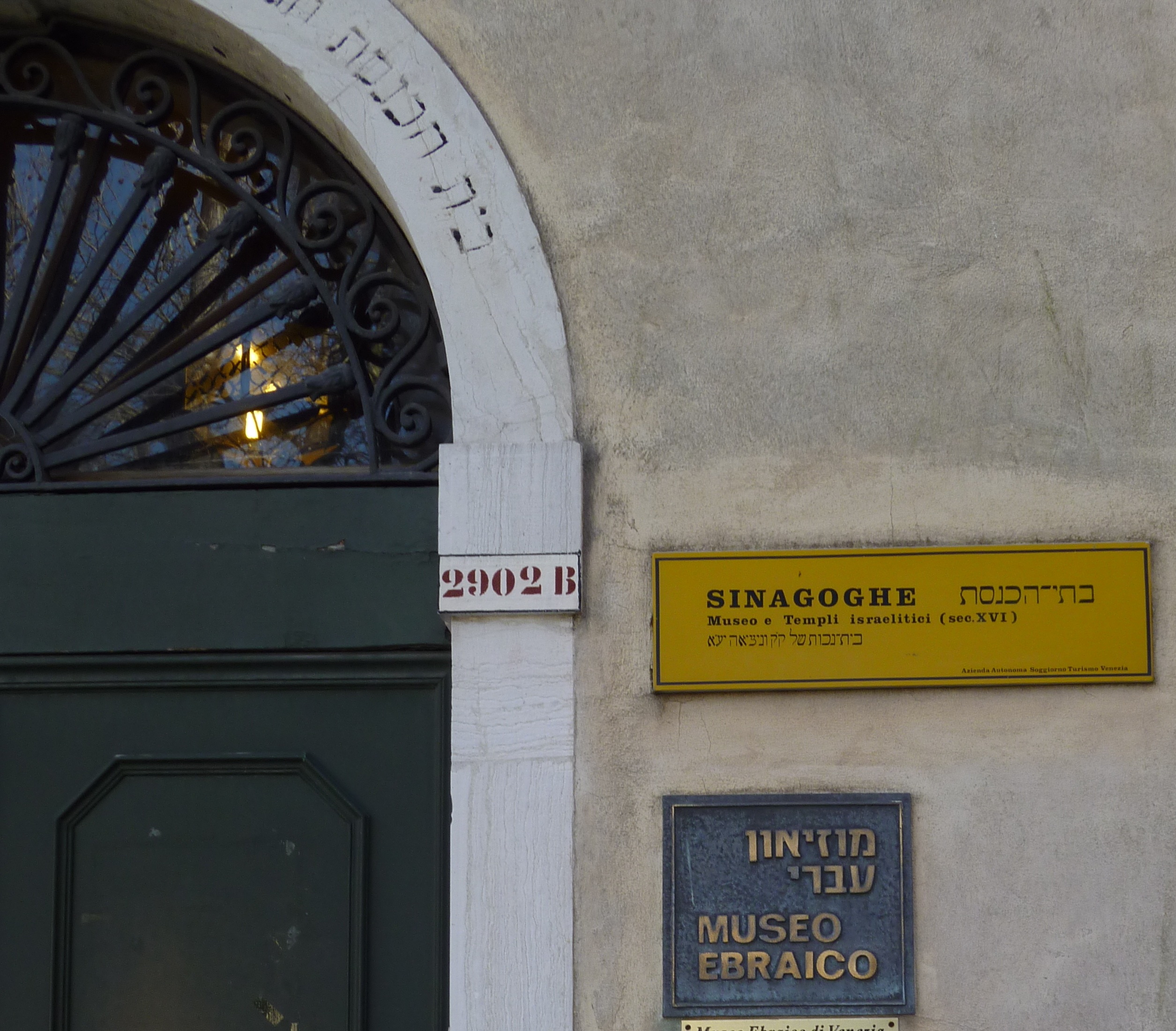
After stumbling upon a synagogue and Jewish museum, I was intrigued to see them both. And thankfully, they were offering tours as a package deal. Once we ate our ‘typical Hebrew styled’ menu at a nearby Israelite hotel, we returned to learn the history behind 3 of the only 5 synagogues there (I’ll talk about the amazing but disturbing history of the Venetian Jews in the 15th century on a future post).

On our guided tour were other Jews, two of which were ascetic. So when the tour guide (who was not a Jew) didn’t have sufficient answers, these friends became talking encyclopedias that added amazing detail. What a joy to be able to ask them any question that came to mind about traditions, history, symbolism etc. And some of what I saw and learned from them and from our tour, is what I want to share with you.

Did you know that….

1. In every synagogue there is a visible reminder, either architectually built into the structure or inscribed on the walls of the entrance, in Hebrew, something to make all entrants aware that ‘this is not the temple, this is not made by God’ and, to  ‘remember the destruction of the temple in Jerusalem’.

2. The Torah (Law of Moses or the Pentateuch) is kept in a holy cabinet called a ‘Holy Ark, which in Hebrew is “Aaron-haKodesh”, beautifully handwritten on scrolls of parchment.

3. The “Aaron-haKodesh” containing the Torah stands on the side of the synagogue that faces Jerusalem. This is mandatory.

4. Women and men have separate seating areas. In the synagogues we saw, the women were on the upper floor while the men would sit on the ground floor. In some cases, women would sit behind the walls and observe through a sort of latticed window.

5. Traditionally, no instruments are to be used during service. They are forbidden during the ‘singing’ of prayers. The Sabbath morning service begins with prayers, typically Psalms orated to a melody. Next, the Rabbi teaches from the Torah, followed by various readings from the Prophets.

6. This next one blew me away, and has set me onto a journey to dig deeper and find the answer to a question it has raised for me. If you know it, post it here and share it with us. Here it is. Uncommon to most synagogues are pictures of any kind. However, this structure had a series of small, carved images along the full length of the walls on both sides, depicting scenes from the exodus and from Mount Sinai. What is so amazing is that in the image at Mount Sinai when Moses received the 10 commandments, there is what looks like small flames or balls of fire coming down from heaven onto the mountain. This depicts God speaking to Moses and were the ‘flaming words of God’. Does this remind of you anything? It did me. Pentecost. Here are the verses from our New Testament:

And suddenly there came from heaven a sound like a mighty rushing wind, and it filled the entire house where they were sitting. And divided tongues as of fire appeared to them and rested on each one of them. And they were all filled with the Holy Spirit and began to speak in other tongues as the Spirit gave them utterance (Acts 2:2-4).

So I asked our Jewish friends if in their history they have always depicted the event at Mount Sinai as it was painted on this wall. Definitely, she said. Several small flames of fire that depict the flaming words of God. So I wonder, did the Jews present at Pentecost make this connection? Was this to give a visual symbol to all that God once again was speaking by His Spirit, giving utterance in ‘words of fire’? I don’t know, but I promise to research and find the answer!

7. Above the Torah was a large, beautiful crown, like that of a king. I inquired about its significance. The crown always accompanies the Torah, because it represents the regality of God. How interesting! Of course, he is a king. But what came to my mind was the offense committed by his people the day they chose to have a man, a human king, rule over them, just like the other nations (1 Sam 8:1-10). But this also shed light on the words of James, the Jewish half-brother of Jesus, when he refers to the commandments as “the royal law” (James 2:8).

There is more, but I’ll end it here. Stay tuned, and I hope these nuggets have blessed you as they have me!

Jesus on the Great Commission

Here is an interesting nugget on the subject of discipleship. To not get rusty after all my blood, sweat and tears invested in learning Biblical Greek through my seminary study, I’ve been trying to use it daily in my devotional time as well as sermon preparation.

This morning I was following a discussion on leadership and mentoring, which is another way of saying ‘discipling’ in biblical language. This, of course, landed me at the Great Commission in Matt 28:18-20. What I found particularly interesting there is the fact that the only word of Jesus recorded explicitly in the imperative (i.e. impertative means to command or order to do something) form of the Greek was ‘matheteusate’, which literally means to “disciple”. Following this as the direct object (the part of the phrase that receives the action rather than does the action) is ‘all nations’,  written as ‘panta ta ethne’ in the Greek.

We often cite this verse to mobilize our churched people into the field of evangelism and missions. While there is nothing incorrect about this application, ‘GO’ is not the actual emphasis of the great commission. To ‘make disciples’ is the command. The words ‘go’, ‘baptize’ and ‘teach’ are participles in the Greek, which would be like saying ‘while going and baptizing and teaching’. These are all an implicit part of the great commission, but they are merely part of the greater focus and actual command of making disciples as Jesus gave it.

Let me explain why this challenges my approach to ministry. Often, we place the emphasis encouraging people to ‘go’ to the field for missions. Always, we make sure that believers are ‘baptized’ after trusting in Jesus. Sometimes, this takes an all-too-legalistic application as part of a creed or requirement for membership into certain denominations. And few reading this post will argue against the importance of teaching others what Jesus did and said. However, my execution of making disciples has fallen far short of what I believe Jesus to have said in Matthew 28:18-20.

Discipleship in light of Jesus’ definition as a Jewish rabbi in New Testament times is to be our goal. A disciple in Jesus’ day was a student who learned closely from his teacher – both by example – and by instruction. Much time was spent together between instructor and disciple. There was a hands on approach too, an apprenticeship if you will. In all, there was a careful nurturing in order to bring the disciple to a specific destination in knowledge and application so as to form his or her character. In other words, we can go, baptize, and teach, without ever truly making a disciple as Jesus intended. For those elements don’t make a disciple. Knowing Christ, walking with him and picking up ones cross to follow him, living by faith and loving Jesus. These describe what I see in the New Testament disciples.

While I have focused often on evangelism, and weekly on teaching, I have fallen pretty far short of Jesus’ definition, and need to reconsider how I am making disciples. Surely my pulpit time goes but a limited distance on the road to Emmaus.  May the Lord, the master disciple maker himself, teach us to make disciples, lest we be guilty instead of fulfilling the ‘Great Omission’.