
Tag Archives: Prayer

An Amazing Day in a Jewish Ghetto

Discovery is a never-ending adventure, and today’s trip to the Jewish ghetto in Venice, Italy, was no exception. After nearly 9 years of living in Treviso, a lovely little city nicknamed ‘little Venice’ for its many water canals and close proximity, my wife and I finally made it to Venice on, (cough) a date! No guests to show around, no baby strollers to carry up and down the innumerable stairs and canal bridges. Just the two of us. Very cold and windy, but what a blessing it was!

We had planned to go to a modern art museum, but why, I don’t know. We are neither knowledgeable of, nor all that interested in, art. But, we figured we would do something different. Once we exited the train however, we remembered there is a Jewish ghetto close to the station. Of the dozens of times we have been to that watery city, this was the first that our feet touched pavement in the historical Hebrew sector. And let me tell you, we are glad they did! It was the closest we have come to Israel and it really made us long to be there.
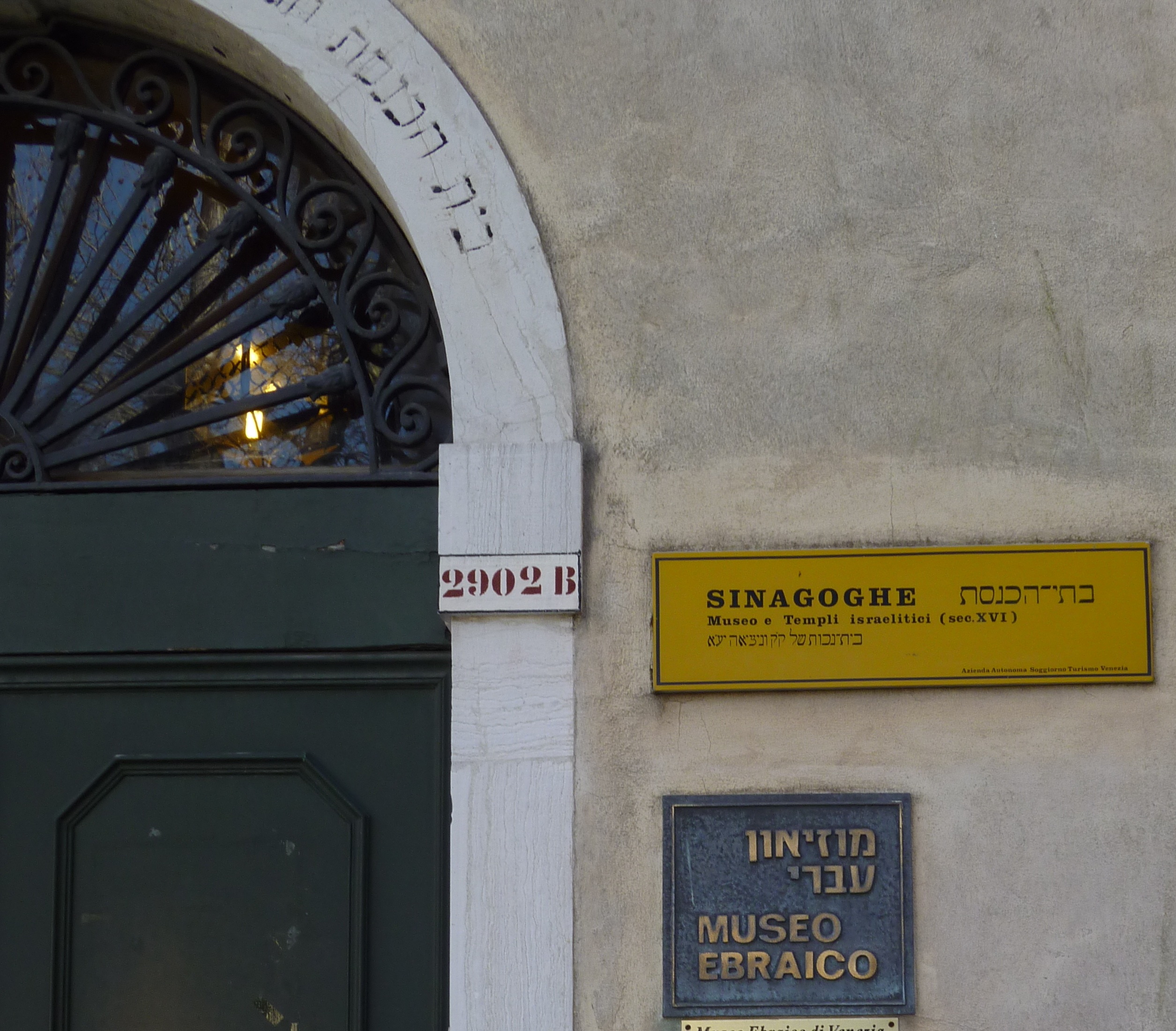
After stumbling upon a synagogue and Jewish museum, I was intrigued to see them both. And thankfully, they were offering tours as a package deal. Once we ate our ‘typical Hebrew styled’ menu at a nearby Israelite hotel, we returned to learn the history behind 3 of the only 5 synagogues there (I’ll talk about the amazing but disturbing history of the Venetian Jews in the 15th century on a future post).

On our guided tour were other Jews, two of which were ascetic. So when the tour guide (who was not a Jew) didn’t have sufficient answers, these friends became talking encyclopedias that added amazing detail. What a joy to be able to ask them any question that came to mind about traditions, history, symbolism etc. And some of what I saw and learned from them and from our tour, is what I want to share with you.

Did you know that….

1. In every synagogue there is a visible reminder, either architectually built into the structure or inscribed on the walls of the entrance, in Hebrew, something to make all entrants aware that ‘this is not the temple, this is not made by God’ and, to  ‘remember the destruction of the temple in Jerusalem’.

2. The Torah (Law of Moses or the Pentateuch) is kept in a holy cabinet called a ‘Holy Ark, which in Hebrew is “Aaron-haKodesh”, beautifully handwritten on scrolls of parchment.

3. The “Aaron-haKodesh” containing the Torah stands on the side of the synagogue that faces Jerusalem. This is mandatory.

4. Women and men have separate seating areas. In the synagogues we saw, the women were on the upper floor while the men would sit on the ground floor. In some cases, women would sit behind the walls and observe through a sort of latticed window.

5. Traditionally, no instruments are to be used during service. They are forbidden during the ‘singing’ of prayers. The Sabbath morning service begins with prayers, typically Psalms orated to a melody. Next, the Rabbi teaches from the Torah, followed by various readings from the Prophets.

6. This next one blew me away, and has set me onto a journey to dig deeper and find the answer to a question it has raised for me. If you know it, post it here and share it with us. Here it is. Uncommon to most synagogues are pictures of any kind. However, this structure had a series of small, carved images along the full length of the walls on both sides, depicting scenes from the exodus and from Mount Sinai. What is so amazing is that in the image at Mount Sinai when Moses received the 10 commandments, there is what looks like small flames or balls of fire coming down from heaven onto the mountain. This depicts God speaking to Moses and were the ‘flaming words of God’. Does this remind of you anything? It did me. Pentecost. Here are the verses from our New Testament:

And suddenly there came from heaven a sound like a mighty rushing wind, and it filled the entire house where they were sitting. And divided tongues as of fire appeared to them and rested on each one of them. And they were all filled with the Holy Spirit and began to speak in other tongues as the Spirit gave them utterance (Acts 2:2-4).

So I asked our Jewish friends if in their history they have always depicted the event at Mount Sinai as it was painted on this wall. Definitely, she said. Several small flames of fire that depict the flaming words of God. So I wonder, did the Jews present at Pentecost make this connection? Was this to give a visual symbol to all that God once again was speaking by His Spirit, giving utterance in ‘words of fire’? I don’t know, but I promise to research and find the answer!

7. Above the Torah was a large, beautiful crown, like that of a king. I inquired about its significance. The crown always accompanies the Torah, because it represents the regality of God. How interesting! Of course, he is a king. But what came to my mind was the offense committed by his people the day they chose to have a man, a human king, rule over them, just like the other nations (1 Sam 8:1-10). But this also shed light on the words of James, the Jewish half-brother of Jesus, when he refers to the commandments as “the royal law” (James 2:8).

There is more, but I’ll end it here. Stay tuned, and I hope these nuggets have blessed you as they have me!

One Son-day Morning

We can’t help but be amazed and challenged by the way Jesus lived his life on earth. I often hear people say things like, “Jesus was God, so it was easy for him to…”, and you can fill in the rest. In other words, because Jesus was the Son of God, they conclude that living a life of dedication and surrender to the Father came at no cost to him. But this is more an excuse for mediocracy in our own lives than it is an observation of Christ’s life.

While it is true he was the Son of God, let’s not forget that Jesus was also a man who lived just as we do today. He was nursed as a baby, was vulnerable to the cold, he hungered and thirsted. And yes, he even had to go to the bathroom. He was not a phantom who left no foot prints in the sand. When he stubbed his toe on a rock, it hurt. He experienced rejection and heartache. By coming in the likeness of sinful man, Jesus subjected himself to all the above and more (Phil 2:5-8), even temptation (Heb 4:15). But he also enjoyed fellowship with God, his father, as it is meant to be for us all.

And this, my friends, is at the core of today’s post. In building on my latest post about our practice of prayer, “The Vacant Prayer Closet“, I want to look at just one aspect of Jesus’ life. You guessed it, his prayer life. This subject alone easily warrants an isolated study, but today we’ll observe only one passage.

“And rising very early in the morning, while it was still dark, he departed and went out to a desolate place, and there he prayed.” (Mark 1:35 ESV)

The day was Sunday, and the hour was approximately 4:00 am. Jesus had spent the entire day before (the Sabbath) exhaustingly busy about his Father’s business (cf. Mark 1:21-34). He had been on his feet from the morning, starting the day by teaching and healing in the synagogue, and carried on all the way into the night, healing the mother-in-law of Peter, and then touching countless lives that desperately gathered at Peter’s door to meet Jesus. It had been a grueling day of ministry indeed. Do you think Jesus went to bed that night not a little tired? You know he did! But notice Jesus’ idea of getting refreshed. It was not to sleep in while missing the best part of the day. He rose early, before the sun, and then pursued a secluded place to commune with the Father.

Folks, as the second Adam Jesus lived his life the way God desires all of us to do (Heb 12:1-3). Therefore, I will be so bold as to prescribe the same for you and me. It has been said, and wisely so, that

“He who fails to seek the Lord in the morning shall not likely find him the rest of the day.”

How did Jesus do it? I can assure you, it was simply his choice to do so. He was not mysteriously infused with a biological clock different to ours that required less sleep. But Jesus also exercised self-discipline. And while that is a word some of us might rather skip over, it is inescapably a quality that should characterize the life of every Christian. Self control is a fruit of the Spirit who works within us (Gal 5:22-23).

Nonetheless, the challenge for us may not be as much in rising early as it is in going to bed early. A simple practice we all would do well to acquire. I believe it was John Wesley who used to say to his evening house guests,

“Gentlemen, it is 10:00 o’clock. Time for all good men to go to bed.”

He literally kicked out his friends so he could go to bed and rise at 4:00 am to pray and enjoy the Lord his God. So, “early to bed, early to rise” is a good practice because we see that Jesus did it. Or at the very lest, he rose early. Also, the Scriptures exhort us to rise early and seek the Lord. But did you also know that studies have shown the following:

1. The sleep we get before midnight is the most beneficial.

2. The most successful and achieving people are early risers.

3. Our most productive time of day physically and mentally is in the early morning hours.

Personally, I love to rise early. But does it come easy for me? No way. Especially if I hit the rack later than prescribed by our wise brother John Wesley. And yet, practically speaking, unless I rise while it is still dark, I can forget about getting quiet time with my Lord. My Biblical studies will be gone with the dawn. Instead, my feet will hit the ground running to the sounds of my children crying, the dings of email filling my inbox, the demands of the day and my ever- growing task list. Behold, I will attempt the day’s journey on an empty tank, with nothing to offer others, let alone to keep myself going.

So let’s learn from our Lord, and follow in his footsteps. Cultivate quiet times alone with God in the mornings, and if 4:00 am is too early for you, find a time in the morning that works (quiet and alone is key) and stick with it. You will find no greater way to be refreshed. You’ll also be amazed at how much you get done and how blessed your day is when it is given over to Jesus first thing.

What do uThink? Does this model work for your daily quiet-time with the LORD? If not, what are the obstacles you face and what alternative do you propose for keeping in fellowship with God? You can post your thoughts in the comment section below, I’d love to hear from you.

The Vacant Prayer Closet

I’d like to put something out there to all of you for discussion today. As the title suggests, it has to do with our prayer closet. Not the physical place we go to pray in private, but the practice of prayerful communion with the Lord himself. For the vast majority of Christians, the prayer closet remains a vacant place.

Today as I was sending an email reminder to our church that tomorrow evening is our monthly prayer meeting, I was struck by the discouraging reality of how few people ever come to a prayer meeting. This is not a phenomenon unique to our fellowship, but rather is more of a problem that continues to plague the modern church. And more importantly, I believe, prayerlessness is largely the reason for the ‘sensate’ lives lived by the majority of professing believers in the affluent West.

So, I must ask some questions, which I hope you will help me to answer.

1. Why wouldn’t a Christian, if s/he is truly that, want to pray and commune with the Lord and Savior of his/her soul?

2. Why wouldn’t a true believer find joy and look forward with excitement to the opportunity of locking arms with other brothers and sisters in Christ for a time of corporate prayer together, as we see with the early church in the book of Acts?

3. Is the lack of corporate prayer indicative of a lack of private prayer?

4. Is prayerlessness a sign of carnality, or is it a sign of something else?

5. Do you struggle with private prayer, corporate prayer, or both? If so, why do you think this is the case? If not, what are the reasons you enjoy participating and what would you say to those who do not share your experience?

6. Do you pray and attend prayer meetings because you want to be obedient to the Words of Jesus and the Apostles as they exhort us in the Scriptures, but nonetheless you do it reluctantly? And if so, what is your experience after you have participated? How would you encourage others who struggle to overcome the complacency or resistance of the flesh?

I’ve got many thoughts I would like to share on this, and I hope to encourage more prayer in all our lives, but the topic would become a very large post. Instead, I’ll break it up into segments. In the meantime, rather than ranting from my soap box, I prefer to know what uThink. Click on the ‘comment’ link below, and post your thoughts. Let’s discuss together this most-important topic.

Blessings in Christ to you today and throughout the week!